AI Interconnection for Hyperscalers: Why the Network Is Now the Bottleneck
If you are building hyperscale AI infrastructure and the network is part of the conversation, FD-IX.ai is worth talking to early
The race to build larger, faster AI infrastructure is accelerating every day. Hyperscalers are spending tens of billions of dollars on GPU clusters, custom silicon, and data center campuses. But one challenge is moving interconnection to the center of every serious infrastructure conversation.The network connecting your compute is no longer a secondary concern. For AI workloads, it is the constraint that determines whether your hardware investment actually delivers.
What Is AI Interconnection?
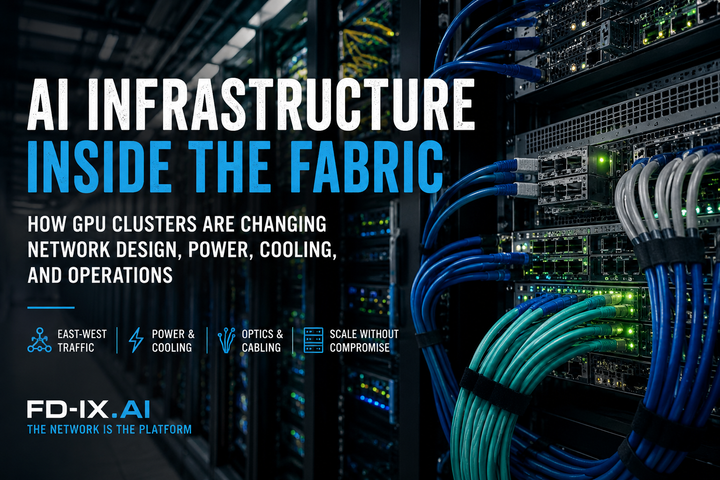
AI interconnection is a high-speed, low-latency network fabric that links GPU clusters, storage systems, and data centers together. Unlike traditional enterprise networking, which handles short bursts of traffic to the Internet, AI interconnection must sustain massive, continuous east-west traffic flows between nodes.Picture a training run with hundreds of GPUs all moving in unison. Every node is constantly passing gradient updates back and forth across the fabric. The moment one link gets congested or slows down, it is not just that node that feels it. Every other node sitting in that synchronization chain stalls out waiting for it to catch up.
Why Traditional Networks Fail AI Workloads
Legacy network infrastructure was designed for a fundamentally different traffic model. Enterprise racks generate periodic bursts toward cloud applications and internet services. This is referred to as North-South traffic. Traffic patterns are unpredictable but individually small. Oversubscription is common and generally acceptable. AI infrastructure breaks every assumption that legacy design was built on.
Sustained, not bursty. Most network provisioning is built around averages. Average load. Average utilization. Average burst duration. GPU clusters throw that math out entirely. Once a large training job kicks off, utilization stays high for days. That is a completely different stress profile than anything legacy infrastructure was sized for.
East-west, not north-south. Legacy networks move traffic toward the Capital I Internet. AI traffic mostly never gets there. It stays within the fabric, moving laterally between compute and storage nodes throughout a job. That puts pressure on exactly the switching layers that were provisioned as secondary infrastructure. They were not built for this, and it shows.
Latency-sensitive. Drop a few packets in a virtualized cluster, and it’s not really noticed except on maybe a graph. Drop them in a GPU fabric, and the whole job can suffer. Synchronized nodes cannot absorb retransmissions.
Multi-sites in use. Many AI deployments now span multiple data centers. They might even span regions. Storage can be in one facility and inference or training nodes in another. Routing that traffic over standard internet transit introduces path instability that AI workloads cannot absorb.
The BGP Problem No One Talks About
One of the most overlooked risks in AI infrastructure is the behavior of Border Gateway Protocol under sustained AI workloads.BGP was created to optimize for reachability and policy, not application performance or timing consistency. When BGP selects a "best path," it is making a decision based on routing attributes like AS path length and local preference. It is not making a decision based on what is best for a synchronized GPU training job.
As a result, the path carrying your AI traffic can shift without warning. A peer network making an internal routing decision you never see can alter latency between your clusters mid-training run. From a routing perspective, the network is behaving correctly. From a workload perspective, nodes that were synchronized are now degrading.
Engineers often spend hours investigating compute or application issues before discovering that the root cause lies in a network path change. The network was up. Routes were valid. Packets were flowing. The network is now the problem.
The solution is to reduce BGP's influence on traffic that cannot tolerate instability. Controlled interconnection can move critical AI flows onto defined paths that remain stable regardless of what the Capital I Internet is doing.
How FD-IX.ai Solves This for Hyperscalers
FD-IX.ai was built specifically to solve interconnection at hyperscale. Unlike legacy exchange points or retrofitted colocation networks, FD-IX.ai is an AI-native interconnection fabric designed from the ground up to meet the demands of hyperscale AI workloads.
AI-Native Architecture
FD-IX.ai was not adapted from existing infrastructure. It was architected specifically for the traffic patterns and stability demands of modern AI deployments. That distinction matters. Retrofitted networks carry the compromises of their original design regardless of how much hardware is added on top.
400G and 800G Native Connectivity
100G is not enough. 200G is not enough. 400G helps. GPU clusters scale quickly, and once training jobs get large enough, the interconnect becomes the bottleneck. FD-IX.ai supports native 400G and 800G ports, and the roadmap already accounts for what comes after.
Stable, Defined Paths for Critical Flows
BGP is terrible at guaranteeing the same one twice. For AI traffic that depends on timing consistency, unpredictability can be an issue. FD-IX.ai lessens those BGP decisions by keeping AI traffic local. The path is defined before traffic ever starts moving.FD-IX.ai is built for more bandwidth in a smaller footprint. As AI deployments grow, the ability to add capacity without redesigning the network hierarchy is critical. Capacity scales with workload rather than with aging infrastructure constraints. Bandwidth and low latency are critical metrics inside our fabric.
Open Ecosystem for Hyperscale
FD-IX.ai operates as a true open interconnection fabric. This enables AI companies, hyperscalers, and network operators to interconnect. This eliminates latency and keeps AI traffic on stable paths. FD-IX.ai is built for customers who ask the network question first.
What Hyperscalers Should Look for in an AI Interconnection
Not every interconnection provider is positioned to support serious AI workloads. When evaluating options, hyperscalers should consider:
Native high-speed port availability. 400G and 800G ports need to be standard in AI Interconnection. If a provider cannot commit to optical density at scale, that becomes a constraint at exactly the moment workloads are growing.
Traffic stability. The worst kind of infrastructure problem is the one where everything looks healthy. Compute is fine. Storage is fine. The job is just underperforming. BGP did its job. Your workload paid for it anyway. Direct cross-connects and private interconnections mean that a particular mystery does not show up in your on-call rotation.
East-west fabric design. Providers built for north-south internet traffic patterns will struggle with AI workloads that generate the majority of their traffic laterally across the infrastructure. The switching architecture matters as much as the port count.
Operational openness. Dense GPU environments make network issues easier to notice but harder to diagnose. Providers need to offer the visibility and support that let infrastructure teams isolate issues quickly without hours of chasing issues around and around.
Designed for scale from day one. AI customers do not ease into capacity. Providers who plan for staged growth on AI deployments will consistently find themselves behind.
Getting Started with FD-IX.ai
If you are building hyperscale AI infrastructure and the network is part of the conversation, FD-IX.ai is worth talking to early. The team offers direct access with no commitment required and responds within a day.
Visit fd-ix.ai to start the conversation.