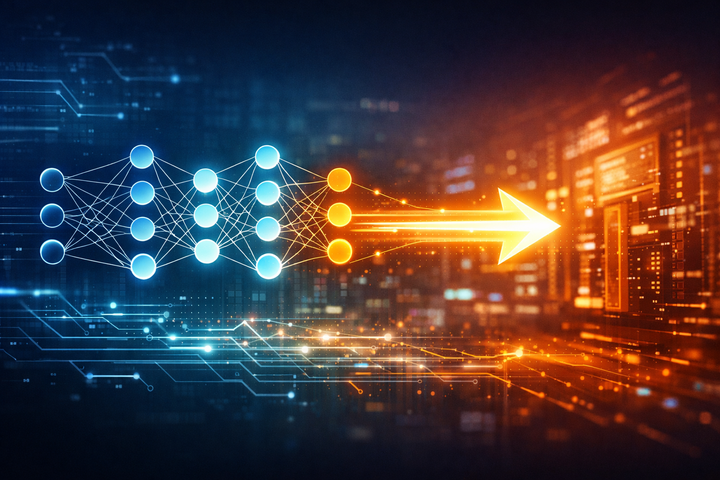
The One-Way Forward Neural Network:Feedforward Models Power Modern AI That design is called a one-way forward neural network, more formally known as a feedforward neural network.
Your GPUs Are Waiting on the Network Distributed training lives or dies on synchronization time. Every millisecond between clusters compounds across epochs.
AI Traffic Breaks Traditional Network Design Most networks were designed for north-south traffic. Users request data. Servers respond. Bursts come and go. AI does not behave that way. Training workloads generate sustained east-west flows between compute clusters. Model checkpoints move in waves. Synchronization traffic spikes across nodes. Storage and compute exchange data continuously rather than occasionally.
AI Infrastructure Is Not Traditional Peering AI workloads do not behave like web traffic. There is no clean “user → server → response” loop. Instead, you have clusters of GPUs exchanging data constantly.
Where Hyperscale AI connects There’s a shift happening in network design, and it’s not subtle. AI is changing traffic patterns in ways traditional infrastructure was never built to handle. It’s not just more bandwidth. It’s a different gravity. Data is no longer moving toward centralized hubs. It’s pulling workloads,
FD-IX introduces AI Gravity Most networks move traffic toward users. AI operates differently. It draws resources toward the compute environment. This effect is called AI gravity. Data, storage, and networks begin to cluster around large AI compute environments, just as planets pull objects into orbit. Once the compute lands somewhere, everything else starts moving