The Hidden Risk in “Best Path” for AI Workloads
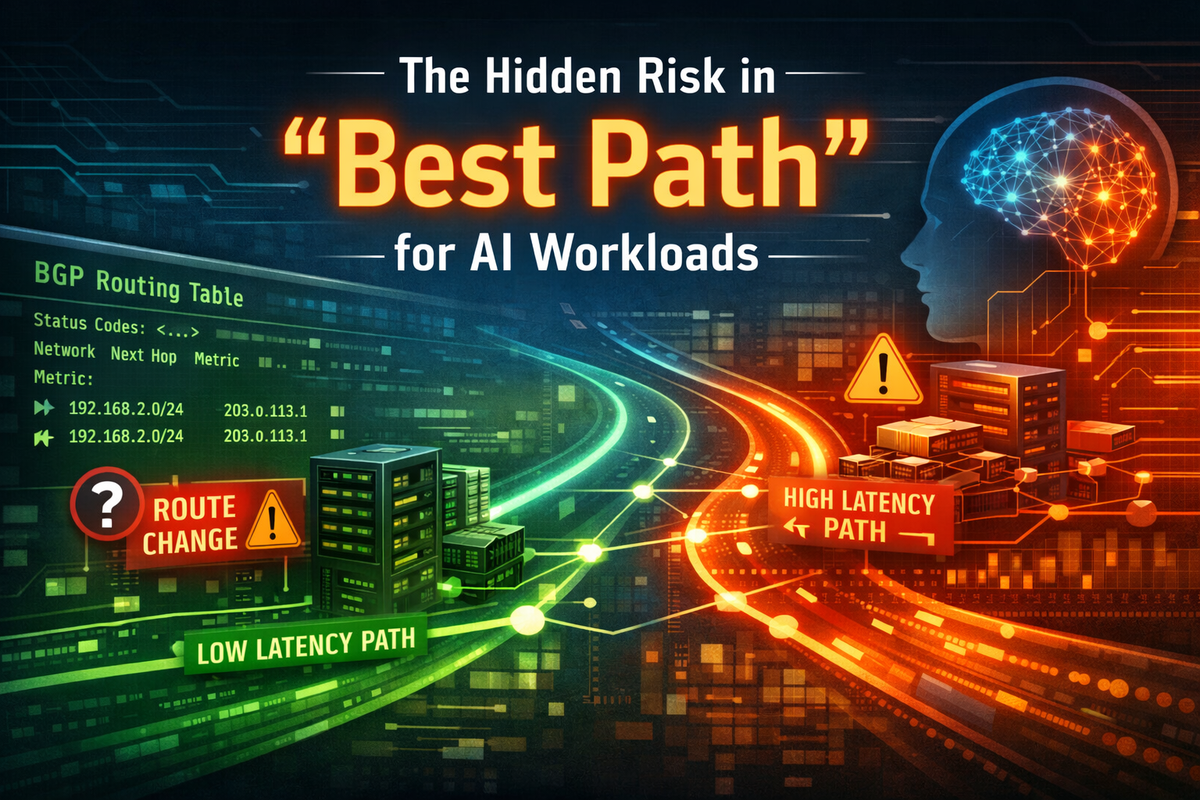
The phrase “best path” sounds more reliable than it really is. In Border Gateway Protocol (BGP), the best path does not mean best for the application. It means the best path based on the attributes the router sees at that moment. BGP defines attributes used to make routing decisions. Traditional web or streaming traffic can tolerate variations in paths and latency. A request might take a slightly longer route, but still completes without much impact on the user. In normal web traffic, milliseconds usually don’t matter.
AI workloads move large volumes of data between systems that depend on each other to maintain low latency. Training clusters exchange state and inference pipelines pull shared datasets. The network is not just moving packets. It maintains continuity between different systems in the ecosystem. This applies both inside the data center and externally across multiple data centers or even across the globe.
BGP makes local decisions and moves on. It evaluates attributes like AS path length and local preference. BGP then installs a route and recalculates when something changes. That change might come from congestion or a peer network making a decision you never see. From a routing perspective, this is normal. From a workload perspective, it introduces instability that is hard to predict and isolate. A path that was consistent a minute ago can shift without warning, even though nothing in your network has changed. FD-IX.ai solves this problem.
A path change during a training run can alter latency. This reduces the system's throughput and overall performance across the board. The shift might be small in network terms, but it is amplified at scale. When nodes fall out of sync, the workload slows unevenly. This is where the gap between reachability and reliability appears. The network is up, routes are valid, and packets flow. Yet the workload no longer behaves as intended.
Engineers often start troubleshooting compute, storage, or application logic because symptoms appear there. The root issue is often the path changing underneath the workload. The problem is not that BGP is broken. It does exactly what it was designed to do. It optimizes for reachability and policy, not application performance or timing consistency. There is no intelligence to deal with latency in the BGP protocol.
You can influence BGP path selection, but you cannot make it absolute across networks you do not control. The solution is to reduce how much the network is allowed to decide. Controlled interconnection shifts traffic onto defined paths that remain unchanged under critical workloads. Private exchange points and direct cross-connects ensure stable communication between systems requiring consistent connectivity. FD-IX.ai has a proven method of doing this.
In that model, traffic does not search for a path. It follows one you have already defined. BGP still exists but plays a smaller role in handling critical flows. You give up some flexibility for consistency, which AI workloads require. Stable paths lead to stable behavior, and stable behavior keeps distributed systems aligned.
“Best path” works for general connectivity, but it was never designed for synchronized, high-volume infrastructure traffic. If the network can change its mind mid-process, the workload absorbs the impact whether you see it or not.
if you are a hyperscaler, contact FD-IX.ai to see how we can solve these problems for you.